
Dress Rehearsal for a Bomb

Officers and men assembled on the flight deck of the carrier USS Saidor (CVE-117) to rehearse the safety procedures for an atomic bomb test, June 1946 (Joint Task Force One)
- Face away from Bikini Atoll
- Sit on deck
- Close eyes tightly
- Cover eyes with bended arm against the face
- When the order “Carry on” is announced, all hands may safely observe the beautiful display of colors in the incandescent column of cloud and the gigantic clouds, which follow the explosion.
Bill McGee’s Letter Home (Maybe His Last)
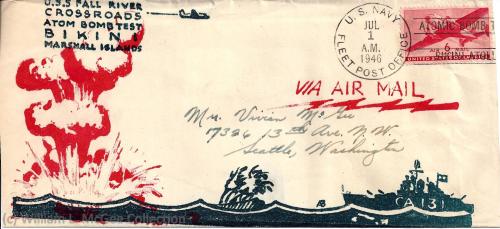
(The McGee Collection)
Two days before Test Able, 29 June 1946, the U.S. Navy issued Fall River officers and crew Operation Crossroads stationery – with the not so subtle suggestion to write a letter home, maybe their last. A special cancellation was applied to the envelope with the killer bars reading “ATOMIC BOMB TEST/BIKINI ATOLL”. Bill McGee wrote to his mother and oldest sister in Seattle, Washington. If his letter sounded casual, it was because he had signed The Secrecy Oath. The penalty for breaking the oath was treason.
Who Was the Only Actor To Have Their Name On An Atomic Bomb

(Los Alamos National Laboratory)
The 21-kiloton Able bomb dropped from the air on 1 July 1946 was nicknamed “Gilda” after Rita Hayworth’s femme fatale role in the 1946 movie of the same name. Soldiers stenciled “Gilda” and an image of Rita Hayworth on the bomb.
It was said Miss Hayworth was furious at her likeness being used on a weapon of mass destruction. She wanted to go to Washington, D.C. to hold a press conference and protest. But Columbia studio head Harry Cohn forbid her to go. “It would be unpatriotic,” he said. It was also said Miss Hayworth didn’t mind the publicity at all.
On 25 July, the Baker bomb, also 21-kilotons, was detonated from underwater and was nicknamed “Helen of Bikini” after the mythological figure Helen of Troy, whose beauty was said to have “launched a thousand ships”. The idea was to equate the bomb’s devastating power to Helen of Troy’s catastrophic allure.
The Army Nurses

(Joint Task Force One)
There were 37 Army nurses stationed at Kwajalein Atoll, 250 miles from Bikini. (Photo: Joint Task Force One)
Bikini (The Swimsuit)

(AFP/Getty Images)
In Paris, on 5 July 1946, Micheline Bernardini, a 19-year-old dancer from the Casino de Paris, wore a brief two-piece swimsuit in public for the first time. It was designed by Louis Réard, an automotive engineer-turned-textile manufacturer. Réard called the swimsuit the “Bikini” after the atomic bomb tests at Bikini Atoll because the swimsuit was causing a “cultural explosion.”
What Was a Short Snorter

(McGee Collection)
The Short Snorter got its name from Alaskan bush pilots. Before taking off, they would have one “short snort” and no more. At Operation Crossroads, a Short Snorter was designed to look like a dollar bill and they were signed by shipmates. Later on in civilian life, if you met up with a shipmate and they couldn’t produce their Short Snorter signed by you, they owed you a short snort.
The Gentleman Calmly Painting After Able

Painting of the Baker bomb blast at Bikini by Arthur Beaumont, 25 July 1946.
Arthur Beaumont, the U.S. Navy’s Official Task Force Artist for Operation Crossroads, was assigned to a stateroom aboard the USS Fall River (CA-131), Flagship for the Target Fleet, responsible for positioning the target vessels in the Bikini Lagoon for Tests Able and Baker in July 1946. Beaumont observed the Able and Baker blasts from the bridge of the Fall River. He made over 180 sketches in pencil and watercolor, plus 16 studio paintings created in his studio aboard ship. Fall River
Yeoman 1/c John J. Skarzenski recalled: “We had these dignitaries aboard and one of them had a stateroom on the starboard side near the exec’s cabin. Right after the Test Able explosion, here was this gentleman calmly painting the cloud as it was forming.” The gentleman calmly painting was Arthur Beaumont.
Don Mozley Reports Live on NBC Radio from Test Baker
At 0835 on 25 July 1946 by the Bikini calendar (24 July in New York), the 21 kiloton Baker atomic bomb was detonated from underwater in the Bikini Lagoon. Though both the Able and Baker bombs were 21 kilotons, the Baker blast was far more dramatic and much more hazardous than the Able blast.NBC broadcasted live radio coverage of Baker from aboard the USS Mt. McKinely. Among the radio personalities reporting was a young Don Mozley.(Recording courtesy the Hoover Institution Library & Archives)

L to R: Don Mozley, Sandra McGee, and Bill McGee recording Bill’s “Learning To Cope With Sight Loss” at Command Productions, Sausalito, CA, December 2009. (The McGee Collection)
Fast Forward 63 years: In 2009, Don Mozley and Bill McGee’s paths crossed at a Broadcast Legends luncheon in the San Francisco Bay Area. Don was by then a renowned CBS broadcast journalist having spent 62 years with CBS Radio and KCBS/74 in San Francisco. Bill had worked for NBC Radio in 1960 in the Spot Sales Division in New York City. The two men had a lot to talk about, including their presence at Operation Crossroads in July 1946.
Bill asked Don to be the narrator of the audio recording of Bill’s sight loss memoir, Learning To Cope With Sight Loss: Six Weeks at a V.A. Blind Rehabilitation Center. Other Broadcast Legends volunteering were TV producer Ed Dudkowski (Bill’s voice) and ABC’s Emmy-winning news anchor Cheryl Jennings (the women’s voices).
The Atomic Cake Controversy of 1946 and Mrs. Blandy’s Hat

(Photo by an unidentified photographer for The Washington Post)
On the evening of November 5, 1946, a celebration was in full force at the Officers’ Club of the Army War College in Washington, D.C. The event marked the disbanding of Vice Admiral W. H. P. Blandy’s Joint Task Force One (JTF-1), organized in January ’46 for Operation Crossroads. At the celebroation, a photo was snapped of VAdm and Mrs. Blandy cutting into an elaborate cake with a “mushroom cloud” top.
The photo sparked a nationwide controversy. The public was outraged by the cake – and Mrs. Blandy’s hat – both resembling an atomic mushroom cloud. Public sentiment was the cake and hat were in the poorest of taste and the atomic bomb was nothing to celebrate.
The Crossroads Book the U.S. Government Pulled From Print

A rare copy of Operation Crossroads: The Official Pictorial Record, November 1946. (The McGee Collection)
In November 1946, Operation Crossroads: The Official Pictorial Record was published by the U.S. Government. The photographs were graphic in nature and perhaps revealed more about the nuclear tests than the U.S. Government wanted to share with the public at the time.Shortly after publication, the book was withdrawn from circulation.
In January 1947, the book was republished with a new title, Bombs at Bikini: The Official Report of Operation Crossroads, and included photographs of a less graphic nature.
Post-Crossroads: The Secret Atomic Cinematographers of the Hollywood Hills
(coming soon)
________________

– Read the Full Story – Operation Crossroads, Lest We Forget! by William L. McGee with Sandra V. McGee. Available on Amazon


